

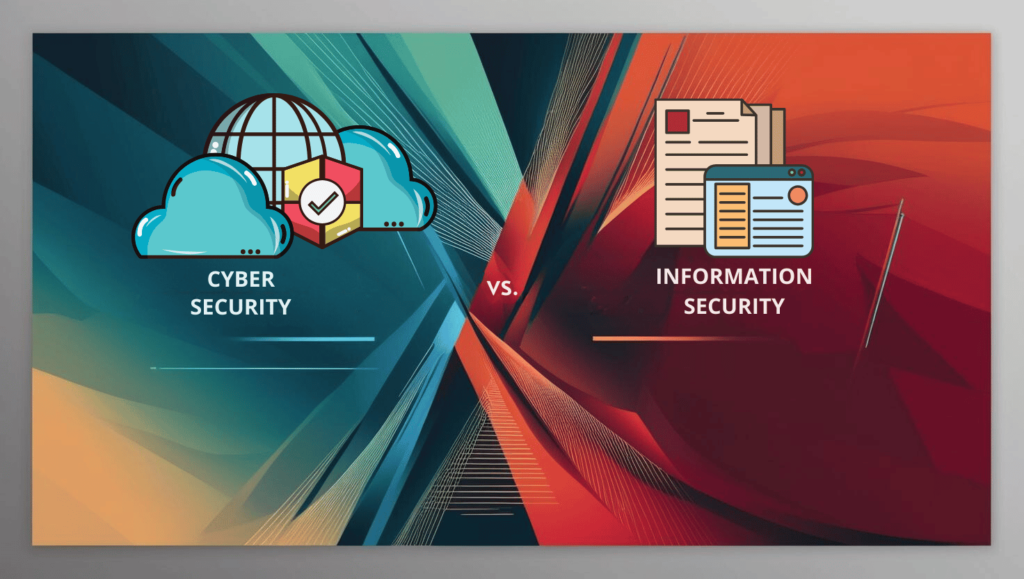
In today’s fast-paced digital landscape, terms like Cyber Security and Information Security are often used interchangeably. While their objectives align, their focus areas differ significantly. Let’s explore their distinctions and discover how they complement each other in safeguarding data and systems.
Cyber Security:
Cyber Security is the practice of protecting internet-connected systems, including hardware, software, and data, from cyber threats. It emphasizes:
- Networks: Ensuring that internal and external networks remain secure from intrusion.
- Systems: Protecting operating systems, applications, and infrastructures from attacks.
- Data: Preventing unauthorized access, alteration, or destruction of digital information.
Common threats in Cyber Security include:
- Phishing: Deceptive attempts to steal sensitive information via fake emails or websites.
- Malware: Malicious software designed to harm or exploit systems.
- Ransomware: Malware that locks users out of their systems until a ransom is paid.
Cyber Security focuses solely on the digital realm, safeguarding the systems and data that power the online world.
Information Security:
Information Security (InfoSec) takes a broader approach, protecting all forms of information—both digital and physical. It is grounded in the CIA Triad:
- Confidentiality: Ensuring access to information is restricted to authorized individuals.
- Integrity: Maintaining the accuracy and reliability of data.
- Availability: Guaranteeing access to information when needed.
InfoSec practices include:
- Data Classification: Assigning security controls based on the sensitivity of information.
- Access Control: Enforcing policies to regulate access to critical data.
- Compliance: Meeting legal and regulatory standards like GDPR, HIPAA, or ISO 27001.
Unlike Cyber Security, InfoSec spans physical records, internal communications, and secure disposal of sensitive documents.
Key Differences Between Cyber Security and Information Security
While both disciplines aim to protect valuable assets, they diverge in scope and focus:
Aspect | Cyber Security | Information Security |
Scope | Focused on digital environments | Covers both digital and physical information |
Goal | Defend against cyber threats | Ensure data confidentiality, integrity, and availability |
Threats Addressed | Malware, phishing, hacking | Data breaches, insider threats, policy violations |
Example Practices | Firewalls, intrusion detection systems | Data encryption, secure physical storage |
How Cyber Security and Information Security Work Together
Cyber Security and Information Security are deeply interconnected. Cyber Security serves as a subset of InfoSec, implementing its principles in digital domains.
For example:
- Cyber Security ensures email servers are protected from hackers.
- Information Security ensures only authorized personnel can access sensitive emails.
Together, they create a robust framework to address both external and internal risks.
Real-World Applications
- Cyber Security in Action:
- A firewall prevents a Distributed Denial of Service (DDoS) attack, maintaining website availability.
- AI systems detect unusual login behavior, thwarting hacking attempts.
- Information Security in Action:
- Physical customer records are secured in a locked room with biometric access.
- Two-factor authentication ensures data integrity during employee logins.
- Combined Application:
- A healthcare provider encrypts patient records (InfoSec) while deploying antivirus software (Cyber Security) to protect against malware.
The Growing Importance of Both
In an era of hybrid work, IoT devices, and cloud services, the need for comprehensive security is more critical than ever:
- Cyber Security addresses the rise of sophisticated digital threats.
- Information Security mitigates risks across both digital and physical domains.
Organizations that neglect either area risk financial losses, reputational damage, and regulatory penalties.
Building a Comprehensive Security Strategy
To safeguard assets effectively, businesses should:
- Conduct Risk Assessments: Identify vulnerabilities in both physical and digital environments.
- Invest in Training: Educate employees on best practices for cybersecurity and information protection.
- Leverage Advanced Technologies: Use AI-driven threat detection, encryption tools, and access control systems.
- Update Policies Regularly: Ensure security measures evolve alongside emerging threats.
Conclusion: A Dual-Focused Approach to Security
Cyber Security and Information Security are two sides of the same coin. By understanding their unique roles and interdependencies, organizations can build a holistic defense strategy that secures their digital and physical assets.
The evolving threat landscape demands a proactive, unified approach to protecting information. Are you ready to strengthen your security framework and embrace the future with confidence?



This looks to be a great blog, talking about Cyber vs information security.